public-api-docs
🔑 Authentication
We use JWTs to authenticate clients when accessing the Wunder Platform.
The response includes a JWT access token, in field accessToken, which is used to authenticate against the Wunder Platform.
The response also includes a JWT refresh token, in field refreshToken, which is used to retrieve a new access token after expiration.
The default expiration time for the access token is 5h. This value can be configured for each tenant.
The access token can also be used to explore the API with Stoplight.
Usage
Use the Widget or the API endpoints:
- Authentication POST /sign-in–email
- Authentication POST /sign-in-api-client
- Authentication POST /sign-in–phone-number (specific for users via OTP)
- Authentication POST /sign-in–email-code (specific for users via OTP)
to sign in and use the retrieved accessToken to authenticate.
The accessToken needs to be passed as HTTP Authorization Header with Bearer {accessToken} as value for API calls.
In case you want to explore the API with Stoplight you can use the widgets to get a JWT access keys for further API calls.
To use these login widgets:
- Login with one of the two widgets below by entering your authentication details
- Copy the value of the
accessTokenfield of the response - When using an endpoint paste the content into the
Tokenfield and make sure that the correcttenantis configured It should look like this: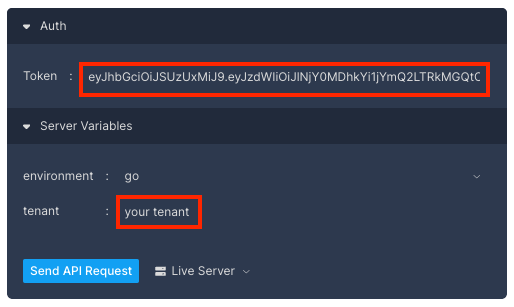
Login Widgets
Standard login (email/password)
These login widgets allow login with username and password and retrieve a standard login token.
```production http { “method”: “POST”, “url”: “/{tenant}/auth/sign-in-email”, “baseUrl”: “https://go.api.gourban.services/v1”, “body”: { “email”: “your email”, “password”: “your secret password” } }
### Login with API key

These login widgets allow login as API client with `clientId` and `clientKey`.

```production http
{
  "method": "POST",
  "url": "/{tenant}/auth/sign-in-api-client",
  "baseUrl": "https://go.api.gourban.services/v1",
  "body": {
    "clientId": "your client id",
    "clientKey": "your secret client key"
  }
}
Token behavior for API clients
- Multiple active tokens per client: Signing in more than once with the same API client (same
clientId/clientKey) issues new tokens without invalidating previously issued ones. All issued access and refresh tokens remain valid simultaneously — a new sign-in does not revoke earlier sessions. - Sharing credentials across services: Using the same API client credentials from several backend services, each maintaining its own token cache and authenticating independently, is a supported pattern. When services serve different user journeys, domains, or purposes — or require different permissions — we recommend creating a separate API client (with distinct credentials) per service, but this is optional and up to your integration design.
User OTP login - phone number and code
Endusers can also log in with their phone number and a one-time-code (OTP) sent to their phone that they need to enter to log in. This method will also provision a fresh user if the phone number is not yet associated with an existing user.
1. Request an OTP code per phone number
```production http { “method”: “POST”, “url”: “{tenant}/front/customers/create-or-sign-in-with-phone-number”, “baseUrl”: “https://go.api.gourban.services/v1”, “body”: { “phoneNumber”: “your phone number”, “branchId”: “home business unit the user belongs to” } }
see [Create or sign in with phone number](../reference/user-api.yaml/paths/~1customers~1create-or-sign-in-with-phone-number/post) for details.

Depending on your tenant's configuration, it might be necessary to provide a signature to prevent foreign sign-ups, DDoS attacks and replay attacks.
See [Signature](/docs/#signature) for details how to calculate the signature on the client-side.

#### 2. Enter OTP code and authenticate

Retrieve the one-time-code (OTP) sent to your phone number and enter it in the request body.

```production http
{
  "method": "POST",
  "url": "/{tenant}/auth/sign-in-phone-number",
  "baseUrl": "https://go.api.gourban.services/v1",
  "body": {
    "phoneNumber": "your phone number",
    "code": "the OTP code you received"
  }
}
see Sign in with phone number for details.
User OTP login - email code
Endusers can also log in with their email address alone and a one-time-code (OTP) sent to their email address that they need to enter to log in. This method will also provision a fresh user if the email address is not yet associated with an existing user.
1. Request an OTP code per email address
```production http { “method”: “POST”, “url”: “{tenant}/front/customers/create-or-sign-in-with-email-code”, “baseUrl”: “https://go.api.gourban.services/v1”, “body”: { “email”: “your email address”, “branchId”: “home business unit the user belongs to” } }
see [Create or sign in with email code](../reference/user-api.yaml/paths/~1customers~1create-or-sign-in-with-email-code/post) for details

Depending on your tenant's configuration, it might be necessary to provide a signature to prevent foreign sign-ups, DDoS attacks and replay attacks.
See [Signature](/docs/#signature) for details how to calculate the signature on the client-side.

#### 2. Enter OTP code and authenticate

Retrieve the one-time-code (OTP) sent to your email address and enter it in the request body.

```production http
{
  "method": "POST",
  "url": "/{tenant}/auth/sign-in-email-code",
  "baseUrl": "https://go.api.gourban.services/v1",
  "body": {
    "email": "your email address",
    "code": "the OTP code you received"
  }
}
see Sign in with email code for details